
5 Questions to ask before choosing a software development partner.
Whether you're a Seed-stage startup, preparing for Series A, or an established enterprise, the development partner you choose today can shape your bus...

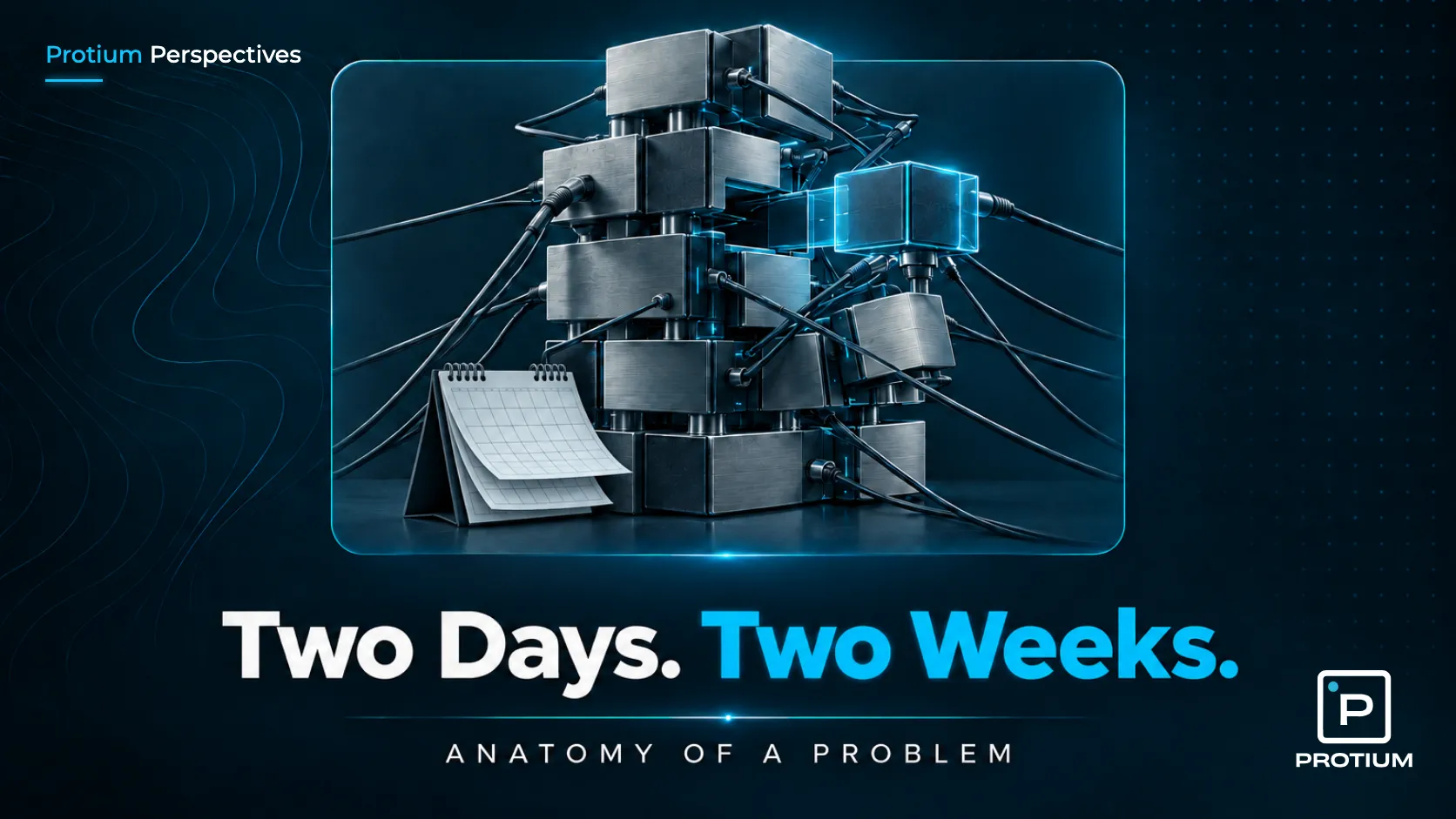
How tightly coupled architecture, accumulated technical debt and short-term decisions turn simple software changes into expensive development projects.
A business needs a small change to its software platform such as an additional field in a client report, a new approval step in a workflow, or a minor adjustment to how information is displayed.
On paper, the requirement is straightforward and the business expects the development team to implement it within a couple of days.
But two days become five. Five become ten. Suddenly, a seemingly simple feature has consumed two weeks of development time.
The obvious questions follow:
Sometimes, those concerns are justified. However often, the problem runs deeper and those are the wrong questions.
The feature isn’t necessarily complicated. Rather, the system it’s being bolted onto is.
Imagine an established financial services platform that is used to manage client engagements, generate reports and support advisory workflows.
The business wants to introduce a new optional section into its client reports, which sounds simple enough. Add the section, make it configurable and ensure it appears in the generated document when selected.
In a well-structured system where foresight and well thought out abstraction was implemented, this might be a relatively contained change. But imagine the existing application was built with report structures, business rules and document generation logic that is tightly coupled.
Suddenly, adding one optional section could mean:
A small feature has become a much larger undertaking. This is not because the business requirement was unreasonable, but because the architecture makes it difficult to introduce change without affecting other parts of the system.
This is an illustrative scenario, not a description of a specific Protium client engagement.
In software engineering, “coupling” or “tightly coupled” describes how strongly different components of a system depend on one another.
Some dependencies are naturally unavoidable. The challenge arises when components are so closely connected that changing one requires modifications across several others, and this is where the art of good software architecture and engineering cmo
Consider a system where reporting rules are embedded directly into application code. That means, every time the business wants to change a report format, introduce a new section or modify a validation rule, developers may need to revisit the underlying implementation. Over time, this could create a growing collection of exceptions, conditional logic and workarounds.
Each individual change might seem manageable, but collectively they make the system harder to understand, test and extend. Eventually, even minor enhancements require extensive investigation.
The cost of development is no longer determined by the complexity of the new feature alone. It’s determined by the complexity of everything that feature touches.
And that’s where technical debt starts affecting business performance.
Most development teams operate under pressure.
There are deadlines to meet, customers waiting for features and business priorities that change.
When a requirement needs to be delivered urgently, the temptation is to implement the quickest solution and this is often mandated by the business stakeholders to meet their pressures.
Sometimes, a tactical fix is entirely appropriate. However, the problem arises when these decisions become permanent without considering their longer-term consequences.
And developers become increasingly reluctant to change existing functionality because they’re uncertain what else might break and this is how technical debt accumulates. It is not necessarily through one disastrous engineering decision, but through many small decisions that prioritise immediate delivery over maintainability.
The time saved today can become the time lost on every future change.
At Protium, our philosophy is that software should be designed not only to meet current requirements, but also to accommodate reasonable change as a business needs naturally evolve.
When a simple feature becomes unexpectedly difficult to implement, the answer isn’t necessarily to add more developers or work longer hours. The first step is to understand why the change is so difficult to implement.
Before modifying the system, it’s important to understand how the relevant components interact.
Mapping these relationships helps identify whether the challenge is isolated or symptomatic of a broader architectural issue.
Without that understanding, another quick fix may simply add to the problem.
One of the most valuable principles in software architecture is identifying which aspects of a system are likely to change and separating them from the components that should remain relatively stable.
Take our reporting example mentioned earlier.
The underlying process of generating a report may remain consistent. However, the sections, content requirements, ordering and validation rules may differ between organisations, products or client engagements.
If every variation requires developers to modify the report-generation engine, the architecture is not decoupled in the right manner and creates unnecessary work and risks.
A more flexible approach might allow report requirements to be defined through configuration or a declarative specification. The reporting engine can then interpret those specifications rather than requiring new code for every variation.
This is the thinking behind architectural approaches such as specification-driven frameworks, reusable components and rules-based validation.
The objective isn’t to introduce complexity, it’s to manage variation in a structured way and allow for future flexibility in new requirements/enhancement in a manner that requires minimal if not no code changes.
When change is anticipated and appropriately isolated, future development becomes easier to manage.
Abstraction is a powerful engineering tool.
It allows developers to separate essential behaviour from implementation details, making systems easier to understand and extend.
But abstraction needs to be applied thoughtfully.
Too little abstraction can result in duplicated code (A core software principle: DRY - Don’t Repeat Yourself) and tightly coupled components.
Too much can create unnecessary layers that make the system more difficult to navigate, understand and maintain.
The goal isn’t to build the most elaborate architecture, but rather it is to identify meaningful boundaries, responsibilities (SRP - Single Responsibility Principle) and reusable patterns that support the business’s actual needs.
At Protium, we believe good engineering requires judgement about where abstraction adds value and where simplicity is the better choice.
One reason a small feature can take unexpectedly long, is the uncertainty surrounding the existing functionality.
Developers may understand how to implement the requested change but are not aware of previous business requirements and all the touch points, so they lack confidence that the change won’t affect something else that it was not intended to.
This often results in lengthy manual testing, repeated fixes and additional regression work.
Automated testing can help reduce that uncertainty.
All of them naturally act as documentation to the intended application business requirements and serve as living documentation of the system
Testing doesn’t eliminate risk, and it doesn’t replace sound architecture, but when combined with clear component boundaries, it can make ongoing development more predictable.
If every new feature requires changes across the same collection of tightly connected components, the problem is unlikely to disappear on its own.
At some point, the business needs to consider whether targeted refactoring would reduce future development effort.
That doesn’t necessarily mean rebuilding the entire platform.
It could involve extracting duplicated business logic, introducing clearer interfaces, separating validation rules or redesigning a particularly problematic component.
The important consideration is whether the improvement addresses a recurring constraint.
Refactoring should be a deliberate investment in maintainability, not an exercise in rewriting software for its own sake.
For business leaders, the consequences of poor maintainability extend far beyond development costs.
Imagine a company trying to respond quickly to changing customer requirements.
The business identifies what needs to be done, but the development team struggles to implement it because every change affects multiple parts of the system.
What should have been a competitive advantage becomes an operational constraint.
The business may experience:
For startups, these issues can become particularly challenging during rapid growth.
For established enterprises, they can limit the organisation’s ability to modernise and innovate.
In both cases, the underlying problem is the same.
The software is no longer enabling the business to move at the speed it needs to.
At Protium, we believe the true quality of software becomes apparent over time.
A system that works on launch day is important, but so is a system that remains understandable, maintainable and extensible as new requirements emerge.
This is why we place such importance on thoughtful architecture, proven engineering patterns, appropriate separation of concerns and strong technical foundations.
Our approach isn’t about overengineering every application or attempting to predict every future requirement, but rather it is about making deliberate decisions that reduce unnecessary complexity and preserve flexibility.
Sometimes that means investing more time in the initial design. Sometimes it means challenging a proposed implementation. And sometimes it means addressing an architectural weakness before adding another feature on top of it.
Because delivering quickly and building sustainably shouldn’t have to be competing objectives.
As the saying goes:
Slow is smooth, and smooth is fast.
The time invested in getting the foundations right can reduce the friction involved in every subsequent change.
When evaluating a software platform, businesses often focus on what it can do today.
Does it meet the requirements? Does it perform as expected? Does it deliver the intended functionality?
But there’s another question worth asking.
How difficult will it be to change tomorrow?
Because businesses evolve, customer expectations change, new opportunities emerge, and technology needs to adapt.
If a feature that should take two days consistently takes two weeks, it may be time to look beyond the individual development task and examine the architecture supporting it.
The objective isn’t simply to deliver the next feature faster.
It’s to build a system where future changes don’t become increasingly difficult.
At Protium, we believe good software architecture isn’t just about making things work. It’s about making them easier to evolve.
How We Build: Foundations > Foresight > Future-Proof
#SoftwareArchitecture #TechnicalDebt #Maintainability #SoftwareEngineering #Protium
Next part coming soon (2 of 3 published)
Whether you're a Seed-stage startup, preparing for Series A, or an established enterprise, the development partner you choose today can shape your bus...

In the dynamic world of financial services, where transactions & user engagements are rapid, complex, and often unpredictable, having a software archi...