
5 Questions to ask before choosing a software development partner.
Whether you're a Seed-stage startup, preparing for Series A, or an established enterprise, the development partner you choose today can shape your bus...

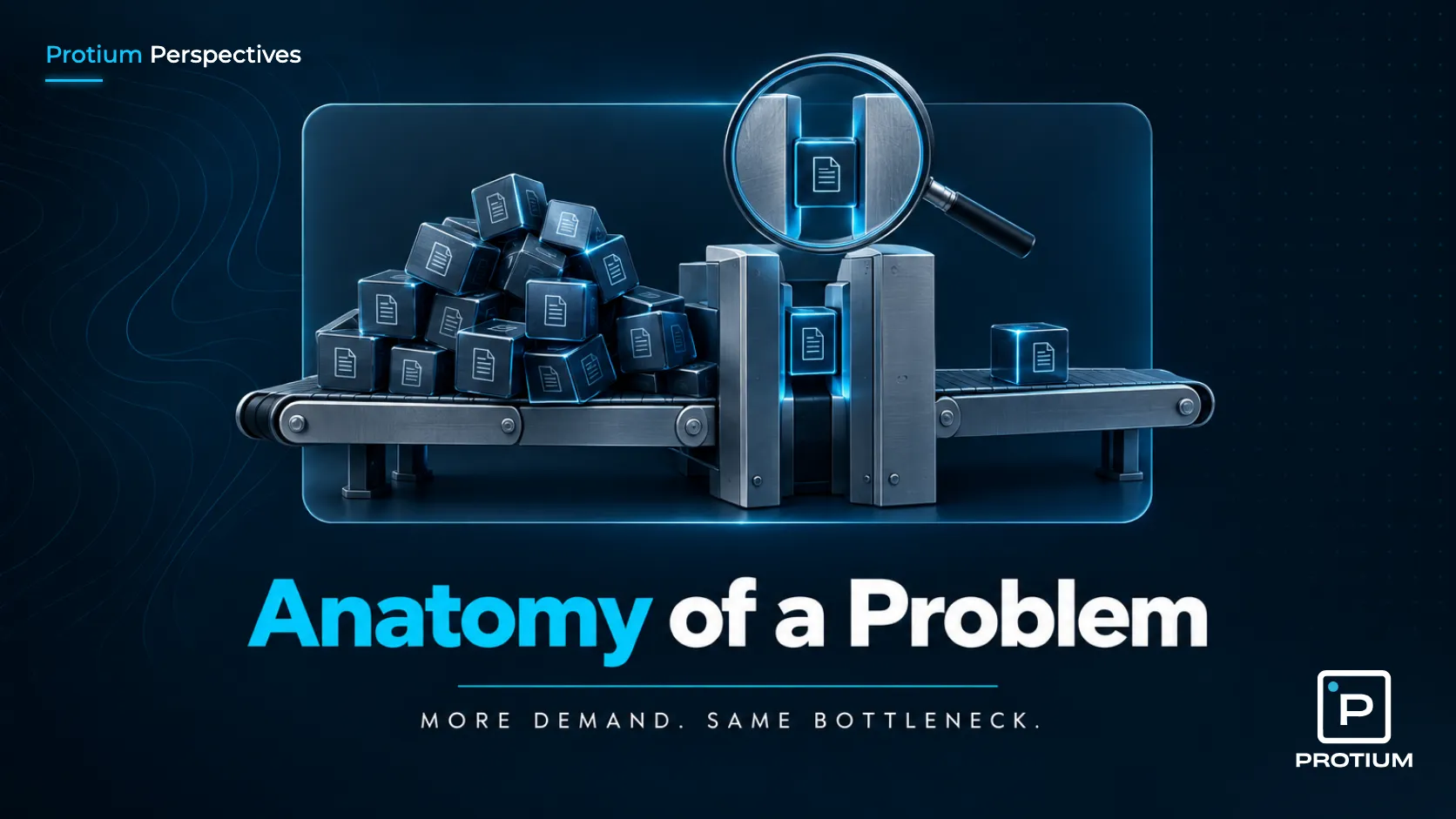
Why successful software systems can become their own biggest obstacle to growth, and how the right architectural thinking changes the outcome.
It’s a scenario that plays out more often than many businesses expect.
A company launches a new software platform. The application performs well, customers are happy, transactions are processed efficiently, and the development team continues introducing new features.
From a business perspective, everything appears to be working exactly as intended.
Then growth happens.
User numbers increase. Transaction volumes climb. More integrations are introduced. New functionality is required, and suddenly, a system that once performed flawlessly begins to struggle.
Response times increase. Processes that previously took seconds start taking considerably longer. Small changes become complicated, and the development team spends more time resolving performance issues than building new features.
The immediate assumption?
We need more infrastructure.
More servers. More processing power. More resources.
But what if infrastructure isn’t actually the problem?
Software architecture is often designed around the requirements a business has at a particular moment.
For an early-stage company, that might mean supporting a few hundred users, a manageable number of transactions and a relatively simple set of business processes.
At that scale, certain architectural decisions may seem perfectly reasonable.
The problem is that these decisions don’t always behave the same way when the system grows.
Consider a transaction-processing platform.
At 100 transactions per hour, processing each transaction sequentially might be entirely acceptable. At 100,000 transactions per hour, the same approach could create significant bottlenecks.
The original solution hasn’t necessarily broken. The operating conditions have changed, exposing limitations in the underlying design.
And that’s an important distinction.
When performance starts deteriorating, the instinct is often to increase infrastructure capacity.
And sometimes, that’s exactly the right decision.
But adding resources to a system with fundamental architectural constraints can become an expensive way to treat symptoms rather than causes.
For example:
In some cases, additional infrastructure simply allows the underlying problem to persist at a higher cost.
This is where engineering judgement becomes critical.
Before deciding how to scale a system, you need to understand what is actually preventing it from scaling.
At Protium, we believe that solving complex software challenges begins with understanding the underlying system, rather than immediately implementing the most obvious fix.
Our approach centres on several important questions.
Performance problems can originate from numerous places.
Database access, network communication, application logic, external integrations, memory management or infrastructure limitations can all contribute.
The first step is to investigate the system’s behaviour and identify where performance is being constrained. This might involve reviewing application telemetry, database performance, transaction flows and the relationships between different system components.
The objective is to distinguish between a capacity problem and a design problem. Because the solutions can be very different.
One of the most common challenges in growing systems is tightly coupled architecture.
When components depend heavily on one another, changes become increasingly difficult.
Appropriate separation of responsibilities and well-defined interfaces can make systems easier to maintain, extend and scale.
But this doesn’t mean splitting every application into dozens of microservices.
Good architecture isn’t about introducing complexity. It’s about managing it.
The right solution depends on the business requirements, the system’s constraints and the trade-offs involved.
This is where many software projects accumulate unnecessary technical debt.
A performance issue appears. A workaround is introduced. The immediate problem disappears.
But the workaround doesn’t align with the underlying architecture.
Months later, another requirement arrives, and the team discovers that the previous shortcut has made the next change significantly more difficult.
Over time, these decisions compound. What initially looked like a quick fix can become a substantial refactoring project.
At Protium, our philosophy is to solve problems at the appropriate architectural level, rather than continually adding exceptions to accommodate individual requirements.
That doesn’t mean every problem needs a major redesign. It means understanding the long-term implications of the decision being made today.
A solution that supports today’s transaction volumes is useful.
A solution that can accommodate reasonable future growth without requiring a complete rebuild is considerably more valuable.
This requires thinking beyond the immediate feature request.
The objective isn’t to predict every future requirement. That’s impossible.
Instead, it’s to establish foundations that make future changes manageable.
Scalability is often discussed purely in terms of how many users or transactions a system can handle.
But there is another dimension that’s equally important.
How easily can the software evolve as the business changes?
A system might handle millions of transactions while being extremely difficult to maintain. It might perform efficiently today but require weeks of development effort to introduce relatively simple functionality. It might scale technically while creating significant operational and financial complexity.
True long-term scalability therefore involves more than infrastructure.
It requires consideration of:
These are interconnected engineering decisions.
And the earlier they are considered, the more options a business generally has.
For technology leaders, architectural decisions aren’t simply technical considerations. They directly influence business performance.
For funded startups, these issues can also become relevant during future investment rounds or acquisition processes, when investors and technical advisors assess the quality and sustainability of the underlying technology.
For established enterprises, they can affect the reliability of business-critical operations.
In both cases, the implications extend well beyond the development team.
Software architecture is ultimately a business decision.
One of the principles we believe strongly in at Protium is that the quickest solution isn’t always the most efficient solution.
Shortcuts can be tempting, particularly when delivery deadlines are tight. But poorly considered shortcuts often introduce dependencies, technical debt and rework that cost significantly more over time.
We favour established engineering patterns, appropriately decoupled components and architectural decisions that support maintainability and extension.
Not because every system needs to be overengineered. But because the right foundations create flexibility.
They allow businesses to respond to changing requirements without continually rebuilding what already exists.
Our philosophy is simple:
How We Build: Foundations > Foresight > Future-Proof
Understand the problem properly. Make deliberate architectural decisions. Build software that can evolve with the business.
Growth should be a positive development for any business.
But when software architecture becomes a constraint, growth can expose problems that were previously invisible.
The answer isn’t always more servers, more developers or a complete rebuild. Sometimes it’s a better understanding of the system, a targeted architectural improvement or a more appropriate approach to managing complexity.
The most important question isn’t simply: Can our software handle the next thousand users?
It’s: Are we building a system that can continue supporting the business as its needs evolve?
At Protium, that’s the question we believe is worth asking from the very beginning.
#SoftwareArchitecture #Scalability #TechnicalDebt #SoftwareEngineering #Protium
Whether you're a Seed-stage startup, preparing for Series A, or an established enterprise, the development partner you choose today can shape your bus...

In the dynamic world of financial services, where transactions & user engagements are rapid, complex, and often unpredictable, having a software archi...