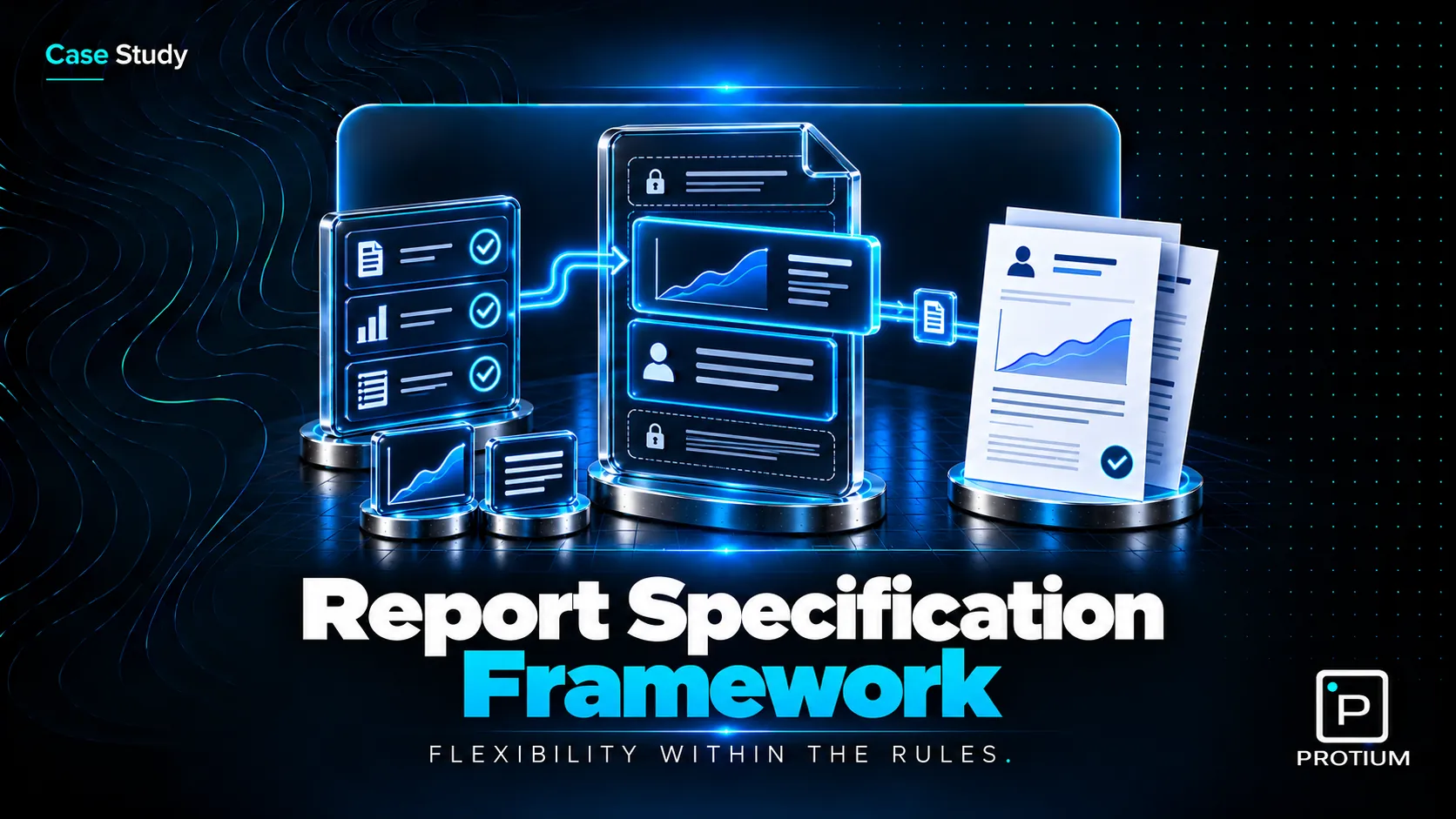
Report Specification Framework - Financial Services
Company size
Enterprise
Location
Cape Town, South Africa
Year
2026
How do you give financial advisors the flexibility to personalise client reports without compromising compliance?
It’s a challenge that goes deeper than simply generating a PDF. In a regulated environment, reports need to follow specific rules.
Certain sections are mandatory. Disclaimers must be included. Content needs to appear in the correct order, and only certain types of information are permitted in particular sections. But advisors also need flexibility.
Every client interaction is different with a different purpose and different outcomes, and the report needs to reflect that. So how do you accommodate both without requiring developers to build a new report template every time something changes?
The solution is to separate the rules from the report itself.
At Protium, we architected a Report Spec Framework, Template builder and Generation Engine to address this challenge.
Here’s how it works:
- Define the rules once.
The organisation establishes a declarative specification framework defining the structure, mandatory sections, permitted content types, content cardinality (number of times specific types of content are allowed to be used) and ordering requirements.
The specification framework also defines where report content & components are required to be specified or materialised, such as during the template customisation process or during the interaction with the client.
- Give advisors controlled flexibility.
Besides provided a set of standardised report templates to advisors to use, advisors can compose, duplicate and customise report templates using a library of reusable components as they require.
A rules engine validates every change against the specification in real time, ensuring that customisation stays within the organisation’s defined requirements.
- Generate the final report.
It is not as simple as just generating a report. This is a very technical part of the process.
This is the meat and where the real value can be seen.
During interactions with a client, certain decisions, scenario’s, proposals, calculations, projections and explanations to concepts may be generated. The framework allows the advisor to use that customised report template and populate it with the desired assets & artefacts that materialised during the discussions with the client, whilst ensuring the report still fully conforms to the specification framework.
The advisor also has, where the specification framework and components allow, the ability to override parts of the client report that they seem fit for the client’s purpose without affecting their core report template.
Once the template is finalised and the advisor is ready to generate the client’s report, the Generation Engine populates each component of the report with the relevant reporting data or user-defined overrides, sources dynamic data it may need and constructs the graphs from the source data. It then renders the completed report in HTML and PDF formats.
The result?
A reporting system designed to give advisors the freedom to tailor their reports while enforcing the organisation’s compliance rules, without requiring developer involvement for every new report variation.
The bigger engineering lesson:
When flexibility and control appear to be competing requirements, the answer isn’t always to compromise on one.
Sometimes, the answer is to design the architecture so that both can coexist.
That’s the kind of problem we enjoy solving at Protium.
#SoftwareArchitecture #FinancialServices #SoftwareEngineering #RegTech