How to Align Business and Engineering Before Work Starts
STORY TIME: Episode 1: "Pre-Flight Briefing" Ground Crew Journal Entry: 9th Feb This week, we reviewed another delayed departure that wasn’t caused by...

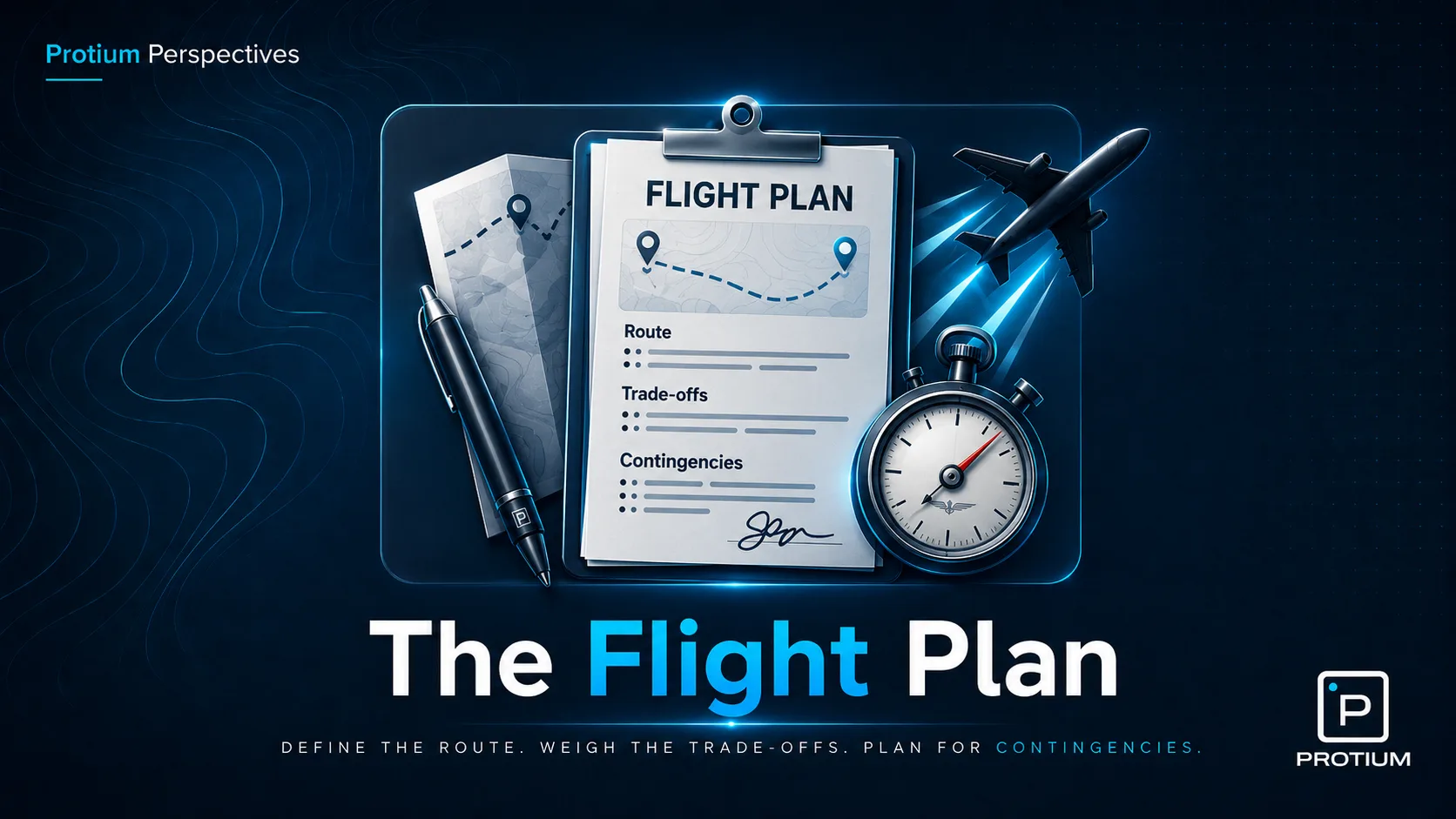
STORY TIME: Episode 2: “The Flight Plan”
Dispatcher Journal Entry: 15th Feb
Our briefings improved alignment, but we still had handover risk.
The flight plan was said to be “clear” until the lead pilot went off shift. Then we realised the route was written down, but the thinking behind it was not. We had lost the why behind the decisions: alternates, margins, constraints, and contingency paths that were understood in conversation but never captured.
So we upgraded the flight plan: not a long document, but a readable plan that any qualified pilot & crew could execute. Route, trade-offs, key decisions, and contingency paths. One page. Signed off.
Translation: Good technical design makes intent portable. It reduces bus factor, rework, and brittle “only X understands this” delivery.
A good feature ticket tells the team what needs to be achieved.
A good technical design helps the team understand:
The goal is not to create a long technical document that nobody reads.
The goal is to imagine the solution clearly enough before writing code so that the team can build, test, review, and hand over the work without relying on one person’s memory.
That distinction matters.
When design is skipped, developers still make design decisions. They just make them privately, under time pressure, while coding. That is where inconsistent naming, duplicated components, missed edge cases, and fragile implementation paths often begin.
One of the biggest misconceptions about technical design is that it belongs to one person.
In mature teams, technical design is collaborative.
At minimum, the discussion should include:
For larger or higher-risk work, the broader development team should be involved too.
That may sound expensive, but it pays back quickly. When the team contributes to the design, the team understands the design. That means less handover risk, fewer repeated explanations, and less dependency on one person’s memory.
It also improves the solution.
A business analyst can clarify requirement intent.
QA can expose scenarios the developers may not immediately think about.
Developers can spot implementation complexity or technical constraints.
Architects can help ensure the solution fits the direction of the platform.
This is where better decisions are made.
Not because everyone agrees immediately, but because the right questions are asked before the codebase has already absorbed the consequences.
Technical design is not purely technical.
If the team is designing the solution and the requirements are unclear, the business analyst or product owner should be close enough to clarify the intent there and then.
Otherwise, the design session becomes a chain of assumptions:
That is dangerous, especially in financial services environments where small wording differences can have large consequences.
For example, “client”, “investor”, “account holder”, “beneficiary”, “portfolio”, and “mandate” may sound interchangeable to someone outside the domain.
They are not interchangeable in a codebase.
The wrong word can send the implementation in the wrong direction. Naming is not cosmetic. Naming shapes the model. The model shapes the behaviour. The behaviour shapes the product.
This is why ubiquitous language matters.
A mature technical design process forces the team to agree on the language before those words become classes, database fields, API contracts, reports, validations, and audit trails.
There is a misconception that technical design slows teams down.
Bad technical design does.
Good technical design does the opposite.
When a story is properly designed before development starts, developers are not constantly stopping to ask:
Those questions are valid. But if they are discovered mid-build, they break flow.
Every unresolved decision adds cognitive load. Every missing clarification creates friction. Every “quick check” becomes a context switch.
A good technical design clears the runway.
When development starts, the developer can focus on writing clean, high-quality code because the team has already agreed on the shape of the solution.
The technical design should not be buried in a separate document that nobody can find.
Ideally, it should live directly on the feature ticket, requirement page, or source-of-truth document.
If that is not possible, it should be linked from there clearly.
The principle is simple:
If someone opens the ticket, they should understand both what needs to be built and how the team intends to build it.
That includes:
This also improves traceability.
When a bug appears later, the team can go back and understand what was requested, what was decided, what was implemented, what was tested, and where the gap may have entered.
In regulated environments, that kind of traceability is not just useful. It is often essential.
A strong design session should create space for simple questions.
In fact, one of the healthiest habits a team can build is this:
Everyone should ask at least one “obvious” or “silly” question during technical design.
Not to waste time. To expose assumptions.
Some of the best design discussions start with questions like:
These questions often pull the thread that exposes the real issue.
They reveal hidden requirements, future constraints, incorrect assumptions, and overloaded terminology.
A mature team does not punish these questions. It welcomes them.
Once the technical design is agreed, the team should create the implementation tasks immediately.
Not later. Not after someone has “had a look”.
There and then.
This is where the design becomes executable.
The team should break the feature into small, clear tasks or subtasks, such as:
This does two important things. Firstly, it makes progress visible. Then secondly, it reduces handover risk.
If a developer is unavailable tomorrow, another developer should be able to:
That is the practical meaning of reducing bus factor.
It is not about replacing people. It is about making delivery resilient.
The goal is to create small, achievable tasks that can ideally be completed in, say, 10–30 minutes. The time doesn’t matter so much, the idea of small does.
There is a human side to this:
When developers can pick up focused pieces of work and complete them cleanly, they build momentum.
Progress becomes visible: “One task down… OH! and another one.. WOW! I’m on a roll! Let me do another one!”.
Reviews become easier. Testing becomes more targeted.
This is not about turning engineering into a checklist exercise, it is about removing unnecessary uncertainty so developers can use their energy on the parts that matter: design judgement, code quality, integration, and problem-solving.
When the thinking is done well upfront, velocity often improves naturally because they stop losing time to avoidable ambiguity.
A practical technical design does not need to be huge, but it should be complete enough to make the work portable.
At a minimum, it should cover:
Requirement summary
What are we solving, in plain language?
Business context
Why does this matter, and where is the platform going?
Ubiquitous language
What terms are we using, and what do they mean?
Technical approach
How will the solution be implemented?
Components impacted
Which systems, APIs, services, screens, jobs, queues, reports, or data stores are involved?
Data sources
Where does the data come from, and which source is authoritative?
Business rules and validation
What rules must be enforced, and where?
Edge cases and permutations
What scenarios could break the happy path?
Testing considerations
What must QA validate? Which devices, roles, permissions, or data scenarios matter?
Tasks and subtasks
What needs to be built, in small executable pieces?
Open questions
What still needs clarification before or during implementation?
Key decisions
What trade-offs did the team agree on?
Part 2 Summary: If technical design in your team often lives in one person’s head, delivery becomes fragile.
At Protium, we help teams make delivery more resilient by connecting requirements, architecture, design decisions, implementation tasks, and testing considerations before development starts.
If you are seeing rework, late-stage clarification, inconsistent implementations, or key-person dependency in your delivery process, we can help you assess where the handover risk is entering the system and put a practical technical design process in place.
Reach out to us for a delivery process or architecture review, and we can help your team move from requirement to implementation with clearer intent, better handover, and less rework.
How We Build: Foundations > Foresight > Future-Proof
Use this checklist directly on the feature ticket, or link it from the ticket as the source-of-truth design note.
Briefly answer:
Define important terms before they become code.
| Term | Meaning | Notes / Avoid Confusion With |
|---|---|---|
| Example: Investor | ||
| Example: Portfolio | ||
| Example: Mandate |
Questions to ask:
Describe the intended implementation in plain language.
| Rule / Validation | Where Enforced | Requirement / Acceptance Criteria Link |
|---|---|---|
| UI / API / DB / Service | ||
| UI / API / DB / Service |
Questions to ask:
Capture the important permutations.
Keep this short and clear.
| Decision | Reason | Trade-off / Consequence |
|---|---|---|
| Question | Owner | Needed By | Status |
|---|---|---|---|
Create these directly on the ticket while the design is fresh.
Suggested task categories:
Each task should be small enough that progress is visible and handover is easy.
Before development starts, confirm:
Next part coming soon (2 of 8 published)
STORY TIME: Episode 1: "Pre-Flight Briefing" Ground Crew Journal Entry: 9th Feb This week, we reviewed another delayed departure that wasn’t caused by...
STORY TIME: Episode 2: "The Flight Plan" Dispatcher Journal Entry: 15th Feb Our briefings improved alignment, but we still had handover risk. The flig...